Generic selectors
Exact matches only
Search in title
Search in content
Post Type Selectors

Category: Past News

SEER Center Director, Paula Lemons, Co-PI on $3M NSF Grant to Transform STEM Education

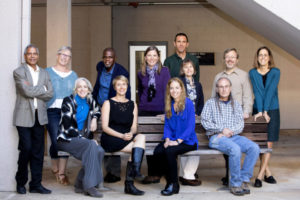
A group of twelve adults, some seated and some standing, pose together outdoors in front of a beige wall and staircase.

Dr. Paula Lemons (Biochemistry & Molecular Biology), Director of SEER Center and OIBR Fellow, received a $3M NSF grant for her project, “STEM Education at a Research 1 University through Multi-Level Action Teams”  to help students better develop STEM knowledge and skills using active learning methodologies.

This project is truly exemplary of interdisciplinary research with four Co-PIs including OIBR Fellow Dr. Erin Dolan (Biochemistry & Molecular Biology), OIBR Affiliate Dr. Tessa Andrews (Genetics), OIBR Affiliate Dr. Peggy Brickman (Plant Biology), Dr. Sarah Covert (Associate Provost for Faculty Affairs) and eight Co-Is from Chemistry, Mathematics, Mathematics and Science Education, Physics and Astronomy, Statistics, Entomology seek to transform STEM education research on campus and nationwide. This research team will work with senior administrators as well as department heads and other faculty members to bring the total number of collaborators to more than 100 over five years.

Beginning in fall 2019, students who take courses in the fields of  biology, chemistry, physics, engineering, mathematics and statistics will begin to see an increased use of active learning methods in their classroom. The research project will continue through 2024, and its long-term goal is to inspire a culture change in the way that STEM courses are taught by faculty and supported by departments and the institution.

To read more about this exciting STEM research project, go here.
OIBR Fellow Receives NIH New Innovator Award

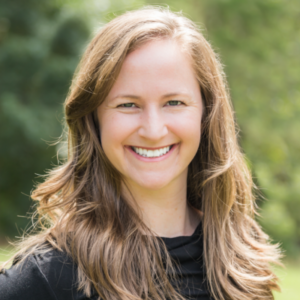
A woman with long light brown hair smiles at the camera outdoors, with a blurred green background.

OIBR Fellow, Katie Ehrlich, assistant professor in the Franklin College of Arts and Sciences department of Psychology, recently received $2.3 million for the Director’s New Innovator Award from the National Institute of Health Common Fund’s High-Risk, High Reward Research program. This new UGA research project seeks to determine whether stressful life experiences have a more immediate effect on children’s health and will implement a new approach to examine how stress exposure is linked to children’s antibody response to vaccination.

Dr. Ehrlich, the principal investigator on the project, noted that the project’s plans came together relatively quickly because of unique resources on the UGA campus. For example, all data collection for the study will take place at the Clinical and Translational Research Unit on the UGA Health Sciences campus and the project will also be relying on two centers on campus – the Center for Family Research (an Owens Institute for Behavioral Research center) and the Center for Vaccines and Immunology.

“Our research is interdisciplinary, and we’re grateful to these centers for helping us carry out complex studies that lie at the intersection of social and biomedical science,” Ehrlich said.

The NIH Common Fund New Innovator Award supports unusually innovative research from early career investigators who are within ten years of their final degree and have not received a research grant or equivalent NIH grant. The program catalyzes scientific discovery by supporting exciting, high-risk research proposals that may struggle in the traditional peer review process despite their transformative potential.

To read about more this exciting research, go here.

Self-Regulation Research by OIBR Fellow, Assaf Oshri

Self-regulation may hold the key to helping young adults overcome their risk for developing alcohol and drug problems, according to recent research led by OIBR Fellow Assaf Oshri, an associate professor in the UGA College of Family and Consumer Sciences.

The study looked at 225 non-college-educated adults aged 18-25 from lower socioeconomic backgrounds who grew up in rural areas. The research team found that young adults who experience abuse as children have a higher risk for developing alcohol and drug problems. These same young adults also have a decreased ability to self-regulate, or avoid impulsive decision-making in socially stressful situations.

Dr. Oshri pointed to the results as evidence of the need for family-focused preventive intervention programs for adolescents that target self-regulation, in hopes of better identifying factors that promote resilience among youth.

To read more about this research, go here.

Trump Signs Bill Funding NIH, HHS, ED, & BLS

Analysis of the Final FY 2019 Labor, Health Human Services, Education, and Related Agencies Appropriations Bill

On September 28, President Trump signed into law a fiscal year (FY) 2019 funding package containing two of twelve appropriations bills, the Defense Appropriations bill and the Labor, Health and Human Services, Education Appropriations bill. The bill had been passed earlier in the week by the House of Representatives. Of particular interest to the social science community, the Labor-HHS bill contains next year’s final appropriation for the National Institutes of Health (NIH), Department of Education (ED), Centers for Disease Control and Prevention (CDC), Agency for Healthcare Research and Quality (AHRQ), and Bureau of Labor Statistics (BLS), among other federal departments and agencies. The passage of the Labor-HHS bill marks the first time in more than 20 years that this bill, which tends to be one of the most divisive among Republicans and Democrats, will be signed into law on time.

At a Glance…

  • National Institutes of Health with $38.084 billion, an increase of 5.4%.
  • Centers for Disease Control  and Prevention with a total of $7.892 billion, a decrease of 1.4%.
  • The National Center for Health Statistics again receives flat funding of $160.4 million, 0% change.
  • Agency for Healthcare Research and Quality, 1.2% increase with a total of $338 million.
  • Bureau of Labor Statistics, with $615 million, a 0.5% increase.
  • Department for Education, a 3% increase to $615.5 million to Institute of Education Sciences.


Read on for COSSA’S analysis of the FY 2019 funding levels.

New Fellows for Fall 2018

Please join us in congratulating the following new Fellows of OIBR!

A man with short brown hair wearing a purple checkered shirt over a white t-shirt sits and smiles in front of a gray background.Geoffrey Brown (HDFS)
Former Grantsmanship Development Program Participant, Dr. Geoff Brown (HDFS) received an R01 from NIH to study how rural environments, social networks and paternal factors contribute to infant development in Black families in the rural South. By focusing on the role of unmarried Black fathers, this work is highly novel and will help to develop interventions to encourage fathers to be actively involved in their infants’ lives.

Profile


A woman with long light brown hair smiles at the camera outdoors, with a blurred green background.Katie Ehrlich (Psychology)
Former Grantsmanship Development Program Participant, Katie Erlich, has recently received a (1) NARSAD Young Investigator Grant from the Brain & Behavior Research Foundation that will focus on proinflammatory phenotypes and depression risk in youth, (2) a R03 from NIH focusing on the effects of exposure to parental depression as a risk factor for downstream youth physical health and (3) a NIH Director’s New Innovator Award for her project submitted to the National Institute on Minority Health and Health Disparities, “Innovative Approaches to the Study of Social Determinants of Health in Children.”

Profile


A woman with shoulder-length light brown hair, wearing a red dress, stands with arms crossed and smiles in front of a tan brick building.Paula Lemons (Biochemistry & Molecular Biology)
Dr. Paula Lemons (SEER center) and her team were just awarded a NSF grant aimed at transforming STEM education at a R1 university through multi-level action teams. This is an outstanding example of truly interdisciplinary scholarship as noted by the team (Paula Lemons, PI; Co-PIs include Tessa Andrews (Genetics), Marguerite Brickman (Plant Biology), Sarah Covert (Assoc. Provost for Academic Affairs), and Erin Dolan (Biochemistry & Molecular Biology). This project has a total of 13 Senior Personnel including individuals from Math, Chemistry, Physics, Entomology, Statistics, Engineering, and Education. Plus many consultants (including yours truly, from Psychology) from different units on campus.

Profile


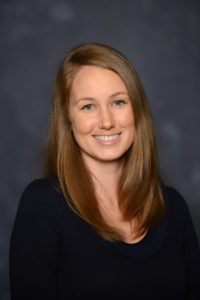
A woman with straight, light brown hair and a navy blue top smiles in front of a plain dark background.


Catherine (Catie) O’Neal (HDFS)
Dr. O’Neal is an Assistant Research Scientist in the Department of Human Development and Family Science and long-time collaborator on a series of projects examining military families and social determinants of health. She was recently awarded a grant from the USDA/NIFA/DOD as Principal Investigator that will evaluate the Air Force Personal Financial Readiness Program to help military families.

Profile


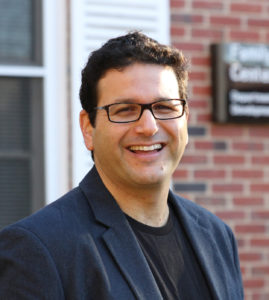
A man with dark hair and glasses, wearing a dark blazer and black shirt, smiles while standing outside in front of a brick building.Assaf Oshri (HDFS)
Former Grantsmanship Development Program Participant, Assaf (HDFS) was recently awarded a K01 award from NIH to examine the influence of community and family protective processes on neurocognitive systems and early onset drug use among rural southern youth.

Profile


Their individual (and collective) success is really incredible!

Dr. Emilie Smith, OIBR Fellow, Announced as Inaugural 2018-2019 SRCD Scholars-In-Residence

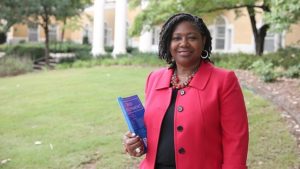
A woman in a red blazer holds a book and stands on a grassy lawn with trees and a building with columns in the background.

We are pleased to announce Dr. Emilie Smith, OIBR Fellow, has been named as one of the first Scholars-in-Residence with the Society for Research in Child Development (SRCD).

The scholar-in-residence program, which was announced earlier this year, is designed to provide researchers time and space in SRCD’s Washington, D.C. office while on academic leave or sabbatical to complete a project, all the while exploring the Society and local scholarly, policy, or government connections. Scholars-in-residence receive funds to supplement existing sabbatical/leave support during their period of residence. Dr. Smith will join the DC headquarters in January of 2019.

Dr. Smith is the Janette McGarity Barber Distinguished Professor and Department Head of Human Development and Family Science at the University of Georgia. She has directed and been involved in research funded for over 50 million dollars evaluating evidence-based practices for supporting families and communities in the prevention of problem behavior and promoting positive youth development.

Building on her research on the benefits of out-of-school time for discovery and inquiry among youth in diverse geographic and racial-ethnic contexts, Dr. Smith’s research while at SRCD will examine implicit mindsets, efficacy experiences, and the socio-cultural effects of afterschool programs on STEM inequality and the development of positive identity for underrepresented students.

Dr. Smith has co-authored a volume entitled, Preventing Youth Violence in a Multicultural Society, and numerous papers on youth and family development, with particular attention to diverse ethnic and social backgrounds. She is Editor of a Special Section of Child Development on Positive Youth Development in Diverse and Global Contexts emanating from her time as Chair of the Ethnic-Racial Issues Committee. She is Associate Editor of the American Journal of Community Psychology and a reviewer for numerous other journals. She is a Fellow of Division 27 of APA and has served on the Executive Board of Social Policy Report and the Governing Council of the Society for Prevention Research.

Two OIBR Faculty Members Named SEC Academic Leadership Development Program Fellows

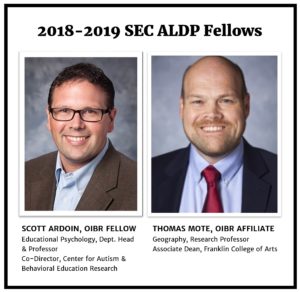
Portraits of Scott Ardoin and Thomas Mote, labeled as 2018–2019 SEC ALDP Fellows, with their academic titles and affiliations listed below their photos.

Scott Ardoin, OIBR Fellow, and Thomas Mote, OIBR Affiliate, are two of four faculty members that were selected as the university’s 2018-2019 SEC Academic Leadership Development Program Fellows.

The SEC Academic Leadership Development Program, which celebrated its 10th anniversary last year, focuses on developing academic leaders within the Southeastern Conference through workshops, networking and campus activities. Fellows will meet with campus leaders throughout the year as well as attend two SEC-wide workshops that help develop leadership skills and an awareness of challenges and opportunities in higher education.

Ardoin, head of the department of educational psychology in the College of Education and co-director of the UGA Center for Autism and Behavioral Education Research, currently serves as education division chair for the Association for Behavior Analysis International and president-elect of the Society for the Study of School Psychology. Ardoin researches applied behavior analysis within school settings and is currently employing eye-tracking technology to study students’ reading comprehension and test taking behavior.

Mote, the associate dean for the physical and mathematical sciences in the Franklin College of Arts and Sciences and a Distinguished Research Professor of Geography, previously served as head of the department of geography and founding director for the Atmospheric Sciences Program at UGA. Mote has worked on numerous projects with NASA, NOAA, the National Science Foundation and Department of Energy. He was named a Fellow of the American Meteorological Society in 2017 and a Fulbright scholar to Brazil in 2008.

To read more, go here

OIBR Congratulates Psychology Faculty for Recent Grant Successes

We congratulate four Psychology faculty members who have recently received national grant awards:

A collage of four people, two women and two men, each smiling at the camera in separate portrait photos.

Dr. Katie Ehrlich (Affiliate) received TWO awards! The first NARSAD Young Investigator Grant from the Brain & Behavior Research Foundation will focus on proinflammatory phenotypes and depression risk in youth and second award is a R03 from NIH focusing on the effects of exposure to parental depression as a risk factor for downstream youth physical health.

Dr. Gregg Strauss (Fellow) received a NARSAD Young Investigator Grant from the Brain & Behavior Research Foundation that will extend his program of research on psychosis by focusing on at risk youth and examining change over time to examine the mechanisms of disease progression.

Dr. Larry Sweet (Fellow) was awarded an R01 from NIH to use neuroeconomics to understand alcohol overevaluation among individuals with alcohol use disorders, using state of the art brain imaging techniques.

Dr. Steve Beach (Fellow), along with Dr. Gene Brody (Fellow) (Center for Family Research and FACS) were recently awarded an R01 from NIH to study the origins of chronic diseases of aging among rural African American young adults.

Congratulations to you all! For more information about these awards, go here

OIBR now accepting Seed Grant Proposals (Deadline is 9/28/18)

The Owens Institute for Behavioral Research (OIBR) is seeking applications for faculty seed grant projects in the areas of social and behavioral science. All faculty in the social and behavioral sciences are encouraged to apply, but OIBR will give preference to proposals from faculty who are currently fellows, affiliates, or grantsmanship development program participants of OIBR. In line with the mission of OIBR, projects must demonstrate a commitment to interdisciplinary research and, as outlined in the program announcement, lead to a full grant proposal submitted through OIBR.

The OIBR Seed Grant Program Announcement (application instructions and details regarding the review process) is below, as well as the OIBR Seed Grant Submission Form.  Please note all completed applications are due on September 28, 2018, and must be submitted electronically to the Assistant Director, Kimberly Cherewick, at ksilvis@uga.edu.  Questions about allowable expenses not referenced on the instructions, or any other facet of the seed grant program, should be directed to Phaedra Corso, Associate Director of OIBR, at pcorso@uga.edu.

OIBR Faculty Seed Grant Program Announcement_FY2019

OIBR_Seed Grant_submission_form_FY19